

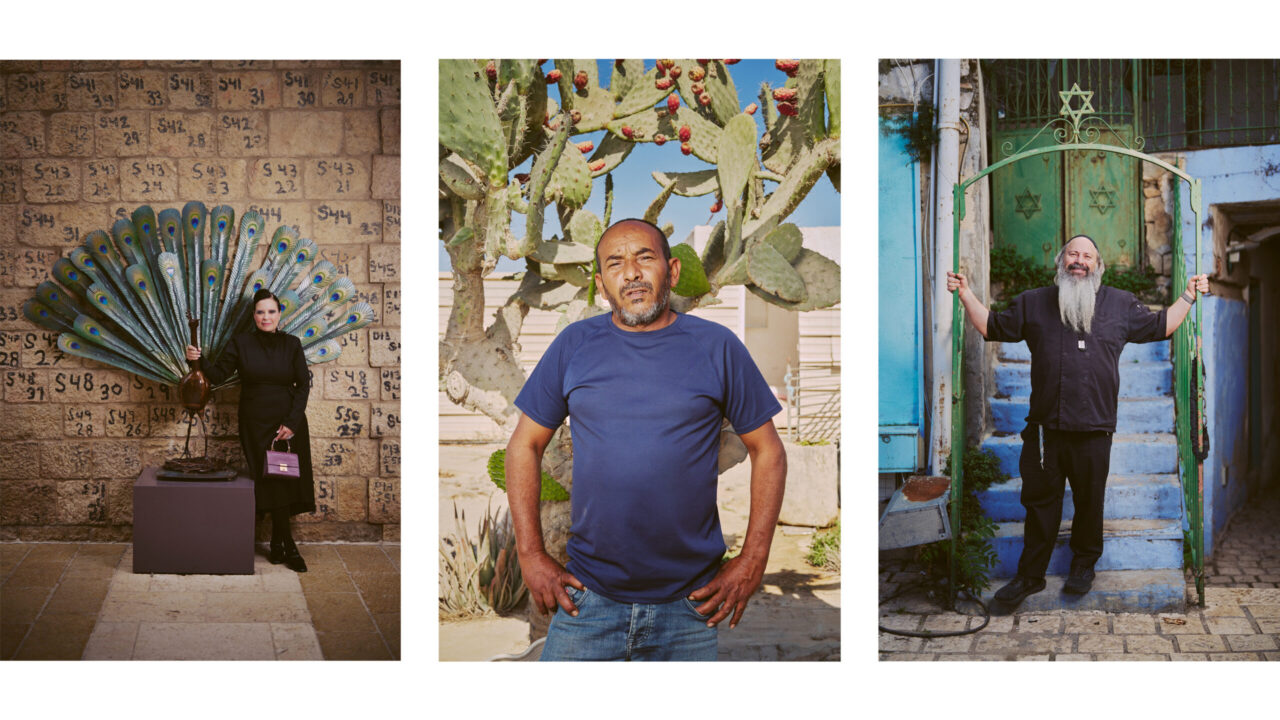
David Shlachter was looking for a project. A Mill Valley real estate investor and avid surfer, he was preparing to spend a few years in Israel with his family and was seeking a creative outlet. So he started to think.
The result is “Hinenu: Israel at Ten Million,” a book of Shlachter’s photography that’s set for publication Tuesday in Israel, with a U.S. release later this month.
His book, whose Hebrew title means “Here we are,” is a portrait of Israel, both on a macro and a micro level. Shlachter took the most recent census data for Israel and shot portraits to match, so that the overall book of 100 people mirrors the picture of modern Israel across many categories: 49% women, 12% living in Haifa, 9% age 50-59, 17% Muslim and so on.

But the photos also come with stories. Shlachter interviewed each subject for the book — people like Ahlam Alkean, a young Bedouin whose life was saved when she obtained a heart transplant, and changed again when she met the family of the donor. Or Daniel Imaran, an Ethiopian Jew who left gang life and organized crime for a career in modeling.
Shlachter plans to visit the Bay Area this month as part of his book tour, with events on Jan. 29 at Manny’s in San Francisco and Jan. 30 at Congregation Kol Shofar in Tiburon. Details of the events are forthcoming at hinenubook.com.
This interview has been edited for length and clarity.
How did you come up with the idea of photographing a cross-section of Israel? And how did you figure out who to photograph?
I started doing research and found that within a few months of us landing in Israel, it was going to hit a population of 10 million.
I thought about the question: Wow, who is Israel? When it was founded, there were only 800,000 people, and now there are 10 million, and they’ve come from over 100 countries, and they’ve mixed together, and they’ve learned the same language — a language that was dead before — and created a whole new culture out of nothing.
We know exactly who these people are, by age, gender, ethnicity, place of origin, where they live within the country, religion. So I took all that data and I thought: Well, how can I crunch this in a way that will give me 100 profiles, so those 100 people together exactly match the demographics of the whole country?
Now we have something where a viewer can just look at these 100 people and without even reading a single story, just by looking at them, some of their assumptions will probably be challenged about who they think Israel is.

What assumptions of yours were challenged while working on this project?
I’m 44 years old. I lived my entire life in this golden age of American Jewry. I never experienced any antisemitism and just felt like a loved member of American society.
Almost immediately after Oct. 7, I started feeling tremendous heat in the environment that was anti-Israel, anti-Zionist. I identify as a Zionist. I think my definition of Zionist is very different than what anti-Zionists think a Zionist is.
There were very threatening messages popping up all over Bolinas, including on the driveway [of our second home]. I tried to engage these people and they wouldn’t speak to me. The one interaction I did have was extremely fraught, and I just felt sick to my stomach afterwards. And I did not show up as my best self, I’ll be honest.
I started developing really negative feelings about groups of people that I didn’t know. It felt wrong. It took me a while, but I finally realized it was the beginning of bigotry developing within me. I had negative feelings about active anti-Zionist activists, but it sort of extended a bit toward Arabs.
Going out here and having to sit down and interview 21 Arab Israelis, because they’re 21 percent of the population — I was very nervous going into the very first interview. My nerves were immediately calmed after two or three questions of engaging with a guy who’s just a phenomenal human.
Some of my favorite people I met out of these 100 are Arab Israelis who are going to be lifelong friends. It was really like a healing process.
Who are the people and how did you find them?
These are regular people. I didn’t seek out luminaries or famous people.
It was all through word of mouth, a totally informal network, never posting anything on social media. And somehow we got everything perfectly dialed in.

What do you think this book will do for readers, other than show them portraits?
I think all of us are completely exhausted after two-plus years of war, after raging antisemitism. So much of our attention has shifted away from the Jewish joy that we used to know to fear and bad news and worry about the future. I think we haven’t really had a lot of opportunities to think about Israel and feel surging optimism or joy.
This is an opportunity to engage with content about Israel that is completely not political. At the beginning of every interview, the first question that was asked [of me] was always, “What’s the political angle on this? Is this propaganda?” I said to everybody, “I could not care less what your politics are. I don’t want to know.”
These stories are apolitical. They are just very raw. They’re very vulnerable. They’re very open, very honest. And if you want to re-engage with Israel in a positive way and feel a lot of inspiration, just read one story, any random story. I promise you will feel it.