

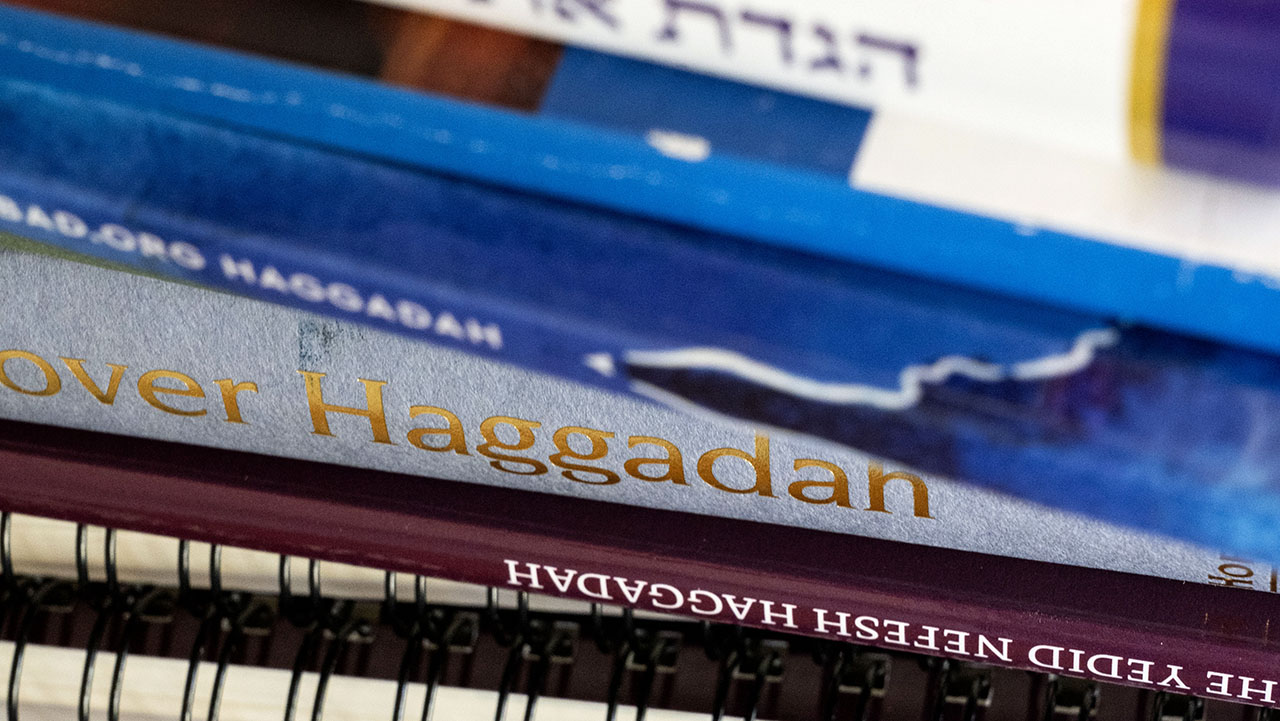
Publishing new haggadahs each year seems obligatory for Jewish publishing houses. I imagine publishers getting antsy at a certain point in the calendar, double-checking to make sure their next haggadah is on track for a pre-Passover release. ArtScroll has a new one this year. So does Koren. And Ktav. And Ben Yehuda. And Mosaic, which actually has three.
I, in turn, feel obligated to review as many of the most interesting new haggadahs as I can get my hands on, year in and year out.
After 15 years of this, I think of them as falling into two groups: practical haggadahs and resource haggadahs.
The practical ones can be handed out to everyone sitting at your seder table: They are priced such that it’s feasible to buy several copies. They are relatively small, so they don’t take up too much space on a crowded table. And if you’re lucky, they’ll even lie flat when open, without constant human intervention.
The resource haggadahs, by contrast, overflow with commentaries, insights, artwork, pop culture references and political polemics that you can use to augment your seder in bits and pieces. But the books themselves are too expensive or too large for everyone to use at a seder.
Though each new haggadah brings its own innovations and oddities to the page, the basic practicalities of them have mattered more and more to me over time, especially since I started regularly hosting and leading a seder at my home. For this reason, in this year’s haggadah roundup, I’m including notes on price, size, format and whether it passes my lay-flat test.
(Last year, I finally purchased a set of matching haggadahs to use for the foreseeable future. “The Yedid Nefesh Haggadah” was affordable and had the content I was looking for — progressive values, traditional text. But just as important, it came in a spiral-bound edition, which can lay flat on the table, even folded over — truly the most practical haggadah format.)
“A Quest for Our Times: The Louis Jacobs Haggadah”
Simon Eder and Adam Zagoria-Moffet, eds. (Izzun Books)
Izzun Books and its co-founder, Adam Zagoria-Moffet, first came to my attention in 2019 with the publication of the first of its Sidduré Or, a series of traditional but egalitarian British Sephardic siddurs (prayerbooks) with phenomenal graphic design and layout. Its new project is a haggadah honoring Rabbi Louis Jacobs (1920-2006), a scholar and founder of Masorti Judaism (Conservative, in American Jewish parlance) in the U.K.

Oddly, despite two introductions and several essays in the back, you don’t learn much about Jacobs himself. The haggadah is written, I suppose, for a British audience that already knows him. Selections from his teachings appear throughout the haggadah, alongside many other contributors — a well-chosen mix of Conservative Jews, Brits and academic scholars — reflecting the mixture of influences and identities that made Jacobs who he was.
The essays in the back are the best part. They include a frank and sensitive alternative to the Four Sons/Children called “The Four Daughters,” which I may use in my seder this year. Other essays include “The Purpose of Questions,” “The Haggadah and Radical Inclusiveness” and, by Jacbos himself, “Passover and Freedom,” which compellingly seeks to reconcile modern and ancient conceptions of liberty.
Practicality: $12. 137 pages. Slim and floppy. Too big for the table. Lies flat when opened in the middle, but not near the beginning or end.
“Haggadah Yehi Ohr: Let There Be Light”
Rabbi Avi Weiss (Ben Yehuda Press)
“Yehi Ohr” is a personal, idiosyncratic work from Rabbi Avi Weiss, who is known for helping define a more socially progressive form of Modern Orthodoxy by ordaining the first Orthodox woman rabbi in America and for taking part in decades of high-profile protests against assorted antisemitic and anti-Israel causes, including that time he was ejected from Auschwitz.

His contradictory qualities — a loud activist also known for his compassionate guiding hand at a beloved shul in Riverdale, N.Y. — are on display in this haggadah. Weiss, for all of his boundary-pushing as an Orthodox rabbi, has the conservative religious Zionism typical among Modern Orthodox Jews. This is evident in his haggadah commentary, especially in the way he positions the modern State of Israel as a fulfillment of messianic yearning. At the same time, the haggadah embraces a more progressive Orthodoxy by putting all of its Hebrew “stage directions” (dip the greens, fill your cup, etc.) in modern Hebrew’s plural gender-neutral form.
Most interesting to me, Weiss has some real insights about the seder’s structure. One example: Some of the beginning parts of the seder are simplified versions of other seder parts to come. Weiss calls the beginning “The Children’s Haggadah.” The Talmud tells us the explanation of the seder plate items and Mah Nishtanah, for example, are meant to get kids to ask questions. As Weiss puts it, “Every step is repeated for adult consumption — in more depth and length — as the Seder moves along.”
Though his commentary is learned and scholarly, he also has helpful, warm tips, such as this suggestion at one point during Maggid (the storytelling portion): “Here, if we are blessed to have grandparents around the table, is a wonderful opportunity to ask them to share their childhood Seder memories.”
Practicality: $29.95. 251 pages. Floppy. A little too big for the table. Lies flat when opened in the middle, but not near the beginning or end.
The JewBelong Haggadah
JewBelong was originally billed as a kind of nonprofit ad agency for Judaism, marketing involvement in Jewish life to “young adults” as a lifestyle brand. It still is that. But starting around the time of the mass shooting at Pittsburgh’s Tree of Life synagogue in 2018 and accelerating since the Oct. 7, 2023, Hamas attack in Israel, JewBelong began using its signature billboards for pointed messages such as “We’re just 75 years since the gas chambers. So no, a billboard calling out Jew hate isn’t an overreaction.”

That’s a big change from JewBelongs earlier cheeky messages of assurance directed at Jews: “So you eat bacon. God has other things to worry about.” Both of those inclinations are present in its new haggadah, which proclaims on the cover, “PASSOVER! The world’s most complicated dinner party.”
This brief haggadah, which has a donation QR code on its first page, includes “Eight Steps to a Kickass Seder,” which is a genuinely helpful guide for first-time seder hosts; a “blessing for anyone who isn’t Jewish,” which is nice; and a version of the Passover story rendered as a screenplay.
There are also a number of parody songs, including one sung to the tune of “Frére Jacques” (“Roasted shankbone, roasted shankbone / Hard-boiled egg, hard-boiled egg”) and the classic “Pharaoh, Pharaoh,” sung to the tune of “Louie, Louie” (“Whoa, baby, let my people go!”). Is this what my fellow Millennials want? Because I think I’d disappear under the table if someone made me sing “Roasted shankbone, roasted shankbone / Hard-boiled egg, hard-boiled egg.”
Unfortunately, this haggadah reflects what I see as JewBelong’s hyperfixation on antisemitism. At one point, it suggests that we feature “strong, black coffee on our seder table” in order to “wake us up to the Ten Plagues of Antisemitism,” which include Social Media, Non-Jewish Silence and Hamas. (Never mind that the Torah’s Ten Plagues led to a good outcome. They freed us from slavery.)
Practicality: $6.99 to order, also free to print. 38 pages. Floppy. A little too big for the table. Lies flat when opened in the middle, but not near the beginning or end.
“The Rock ’N’ Roll Haggadah: Your Guide to a Seder That Rocks!”
By Meredith Ochs. Illustrated by Kay Miller (Simon Element)
This haggadah from music journalist Meredith Ochs wants to be two things and seems to do a remarkably good job of both. It is at once a novice’s guide to leading and understanding the seder, as well as an extended proof of the author’s incredible ability to insert pop music references anywhere and everywhere.

Ochs uses her encyclopedic knowledge of rock history and lyrics as a lens through which to view the seder. The titles of rock songs are dropped as little puns and references throughout the haggadah, each one highlighted in blue type. I don’t understand most of the references, but they don’t detract either.
There is a lot of good introductory material, including a list of everything you need to set the seder table and the history and geography of Passover foods. There are also a number of “Honorable Menschen” interstitials that insert Jewish biographical details and anecdotes about famous musicians, such as “Lou Reed and the Legendary Downtown Seder” and, perhaps inevitably, “Gefilte Fish vs. The Band Phish.”
Practicality: $17.99. 159 pages. Softcover but stiff. Good size for the table. Does not lie flat.
“The Office Haggadah: An Unofficial Scranton Seder”
Dave Cowen and Dan Lerman (Cowen Parody Haggadahs)
I’m not actually a fan of “The Office.” But if you are, consider the latest offering from Dave Cowen, a writer whose work has appeared in the New Yorker and McSweeney’s and the man behind a litany of self-published pop culture and political parody haggadahs, including “Curb Your Haggadah,” “The Yadda Yadda Haggadah,” “The Biden-Harris Haggadah” and “The Meshugah Kanye Haggadah.”

This one takes the shape of a script for a very special Passover episode of “The Office,” in which Michael and the gang must save their office of the Dunder Mifflin paper company from downsizing by securing a contract to print the Maxwell House haggadah. And they must put on a seder to accomplish this — a funny enough idea.
This haggadah wants to impart Jewish values along with the jokes, but it can’t even manage contemporary comedic values. At one point, in an authorial aside, Cowen and Lerman ask themselves if it’s OK to do “these 2000s jokes,” such as casual homophobia and white guys doing cringey accents. I guess because they want to capture the tone of “The Office” as accurately as possible?
They assure themselves that “if we acknowledge our self-awareness, like this, then it becomes OK. Or kind of OK?” Gentlemen, let me suggest that when it comes to writing a Passover haggadah, one might shoot for a moral bar somewhere above “kind of OK.”
Practicality: $8.99. 99 pages. Slim and floppy. Good size for the table. Does not lie flat.
“The Story of the House of MaqSwel Haggadah — With Excerpts from the Torah, Talmud, Mishnah and Kabbalah in the Original Klingon”
Aaron Brachfield, with assistance from the Klingon High Rabbinical Council (independently published)
It is difficult to describe, let alone explain the existence of, this self-published book. Comprehending the title alone requires a load of specialized knowledge. You have to know what Talmud, Mishnah and Kabbalah mean. You have to know about the famous series of haggadahs published by Maxwell House. And you have to know that a complete language exists for the alien Klingon species from “Star Trek.”

Going even deeper, you have to know that if you transliterate “Maxwell” into Klingon and back into English, you’ll end up with “MaqSwel” — and that “Star Trek VI: The Undiscovered Country” includes a joke in which a Klingon leader says, “You have not experienced Shakespeare until you have read him in the original Klingon.”
I’ll leave it at that because I’m 90% certain that the entire audience for this not-quite-haggadah is already a member of Star Trek Jewposting, a Facebook group I founded.
Practicality: Please do not attempt to actually use this around your seder table.
Mix and match with Recustom.com
Recustom.com, the website formerly known as Haggadot.com, releases new digital haggadahs every year. Naturally, this year there is a “Wicked”-themed haggadah, written by friend-of-J. Esther D. Kustanowitz. There is a haggadah for peace, which “centers on harmony and healing, offering prayers for Jewish communities worldwide and expressing hope for lasting peace,” and a 10-minute seder, the very idea of which gives me hives but may be “perfect for families with young children or hungry guests.” Recustom gives you the ability to take material from these haggadahs and myriad others on the website to create your very own haggadah.
Maybe next time…
Here are four new haggadahs of note that I did not get my hands on in time for this roundup:
“The Passover Haggadah of Questions & Answers” by Alan Landau, published by Ktav, appears to be just what the title suggests, a foregrounding of the seder’s fixation on questions.
“Vehigadt Pesaḥ Haggada: Inspirational Reflections for the Seder Night” by Rabbanit Yemima Mizrachi, published by Koren, is a beautifully designed haggadah focusing on the needs of women whose domestic labor makes the seder possible.
“The 2025 Asufa Haggadah, 2025 Edition” is the latest in an annual series produced by the Israeli art collective Asufa, in which each two-page spread is turned over to a different contemporary Israeli artist.
And most exciting to me is a new translation of the “Haggadah for Believers and Heretics,” a “biting political reimagining of the Passover ritual,” first published in the Soviet Union in 1927.
Free haggadah sets for your seder
The Jewish Community Library in San Francisco lends out sets of up to 10 haggadahs to use at your seder, with pickup available in S.F. and Palo Alto.
There are several good options, including some I’ve written about in prior years:
“New American Haggadah” by Jonathan Safran Foer and Nathan Englander (not to be confused with “The New American Haggadah,” also available from the library); “Sharing the Journey: The Haggadah for the Contemporary Family,” the Reform movement’s most recent haggadah; and the Tablet magazine haggadah.
My recommendations from the library’s offerings are “A Different Night: The Family Participation Haggadah” and its sequel of sorts, “A Night to Remember: The Haggadah of Contemporary Voices.” Both are contenders for my all-time favorite haggadahs.
Did you pick up these or any other new haggadahs this year? Which haggadah(s) do you use at your own seders? Write to me at [email protected] and let me know.