
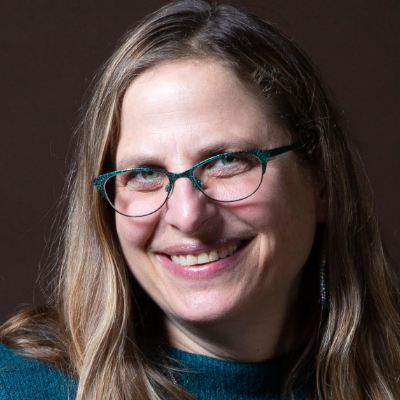
“I’ve always wanted to be involved, and I tried several different routes, trying to find a place for myself,” she explained.
“It can be a difficult place to break into, if you don’t have contacts. When people played ‘Jewish geography,’ I didn’t go to camp with them.”
But when attending High Holy Day services a few years ago at Stanford University’s Hillel, Sandoval came across a flier.
It was the same flier that Jan Weinman of Cupertino saw.
“It said something like, ‘How closely associated are you with the Jewish community, and how much do you want to be?'” Weinman recalled.
It announced the formation of a group called “New Bridges,” designed to welcome those Peninsula Jews who might feel somewhat isolated from the Jewish establishment.
And so far, according to Sandoval, Weinman and quite a few others, the connection is working.
New Bridges can now boast 700 Peninsula households in its database, said Janice Weinstein, the organization’s enthusiastic executive director and organizer. Launched as a pilot project of the Jewish Community Federation in the summer of 1998 through support of the Jewish Community Endowment Fund and a South Peninsula Council grant, the program seeks to overcome the emotional and internal barriers that have kept people from the Jewish community.
One might think such an organization would mostly outreach to newcomers. Not so. Weinstein said New Bridges involves many Jews who had been living in the area for years but had previously given up trying to find their niche in the community.
Joanne Donsky is one such person. A Portola Valley resident for more than 10 years, she said, “I was looking for some connection, but had not found anything for me and my husband.”
When she decided to take part in a New Bridges focus group before the organization was officially under way, she received a phone call from someone she went to college with, a personal connection New Bridges prides itself on coordinating.
“It’s a very lonely experience going to a synagogue and not knowing anybody,” said Donsky, who now chairs New Bridges. The hope is that people will experience new and welcoming encounters through the program, and then feel more accepted at Jewish events.
“That personal touch has been great,” said Sandoval, adding that when New Bridges people say they will call, they do. “If you’re going to synagogue, someone will call and say, ‘Do you want me to meet you at the door?’ Other Jewish organizations don’t do this. They assume it will be so comfortable to walk through the door, but it’s not.”
Weinstein said many Jews feel that if they do not fit the mold of a fairly well-off married couple with children, they do not feel at ease at synagogue.
“We’ve found that we’re most effectively servicing people who feel they’re outsiders, either single parents, singles in their 40s and 50s, or gays and lesbians,” said Weinstein.
The key to the organization’s success, its members believe, is its reliance on focus groups. Usually meeting in a member’s living room, these groups provide an intimate venue for people to voice exactly what they’re looking for in terms of community.
The groups meet based on commonalities and interest: social action, single parents, gay men and lesbians, spirituality and women, to name a few.
“Then we ask what they’re looking for,” said Weinstein, “and what hasn’t worked, and what can they do to create it?”
The focus groups have transformed into a tool to help people connect with each other — not just a method of needs assessment, said Donsky. “And by helping people create what they’re interested in, we’re informing them about the community.”
Weinman, for example, joined a singing group, and she’s invited some of the members she’s met to come over for Shabbat dinners. She’s also been volunteering for the organization, and working at the Bureau of Jewish Education.
“New Bridges has afforded me all kinds of connections, programs and activities,” Weinman said. “They do what they say.”
But New Bridges is also making a difference in the lives of those who are already affiliated. Alan Warshaw of Palo Alto belongs to Congregation Beth Am in Los Altos Hills, but said that since joining New Bridges, his sense of community has greatly expanded.
“A synagogue does not serve all purposes in serving a community,” he said. “New Bridges adds value to my Jewish experience by enlarging my feeling of community beyond one synagogue.”
Warshaw joins on hikes, and has helped organize a singles group for middle-aged people that holds an informal coffee hour every Wednesday. And through this group, he’s made friends that he sees outside of the New Bridges framework.
While New Bridges is now focusing its efforts on the Peninsula, Weinstein hopes it will eventually expand into San Francisco and the East Bay. But in the meantime, she is thrilled with the overwhelming number of people who feel that the program has really accomplished what it set out to do.
“We recognize all these things will not have dramatic effects overnight,” she said, “but subtle effects over a long period of time.”