
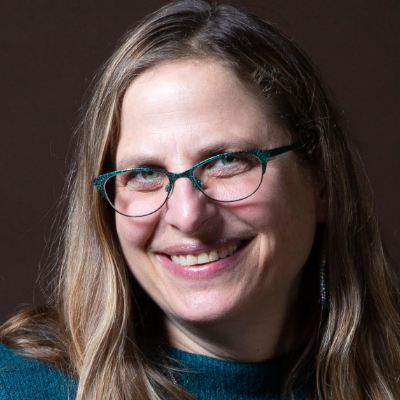
For many of those years, “I had thought what it might be like not to be a lawyer and do something else,” said Kane, a San Franciscan who is 49. “But the dilemma was what else would I do.”
“For quite some time I’ve wanted to do something that uses not only my legal skills but plays into my deep feelings about Judaism.”
So, several months ago, she became the executive director of the Holocaust Center of Northern California in San Francisco.
Kane, who was in private law practice with a partner, had to take a pay cut in her new position. That is often the case — though not always — when making the switch to Jewish communal work.
Yet those who have done so say they like the fact that their job is more than just a job. Among them are Wendie Bernstein Lash, Sharyn Saslafsky, Wendy Bear and Gary Cohn, all of whom spent years working in the secular world, switching to careers in Jewish communal service later.
Calling her decision a “very dramatic shift,” Kane said, “Most rewarding is that we can use the lens of the Holocaust to teach young people to think critically and to learn how to make judgments based on facts rather than on stereotypes.”
On the job since March 1, Kane said she is able to use the best parts of being a lawyer — the negotiating and the people skills — “rather than the aggressive, scorched-earth policy that you might use if you are representing one interest that is paying you.”
Meanwhile, although the dot-com layoffs have resulted in large numbers of people seeking different careers, the Jewish communal world is not seeing large numbers of them, according to Abby Snay, executive director of Jewish Vocational Service.
Out-of-work dot-commers might be considering the non-profit world as a possibility, she said, but “it’s more that the Jewish community might be an option for them. It’s more exploratory.”
On the other hand, Kirsten Netterblad, who works in human resources at the S.F.-based Jewish Community Federation, said she was seeing a lot of former dot-commers applying for administrative positions. In most cases, however, they were asking for unrealistically high salaries and didn’t show a seriousness about the position, she noted.
Lash does not qualify in this category — she left a successful company before the dot-com downturn. The assistant director of the Peninsula’s Jewish outreach organization, New Bridges, Lash, 41, joked that she is donating $70,000 a year to the Jewish community by being a Jewish professional.
The Redwood City resident helped to found an educational software company, which then morphed into an online chat in the days before the World Wide Web.
All along, she had been volunteering for her son’s day school, and as she approached 40, she had an epiphany that she’d like to turn her volunteer work into a vocation.
While the sale of her company and her husband’s salary allowed her the luxury to make that choice, Lash said, “it took a good six to nine months of ego deflation, as I’m making 75 percent less.”
Lash first came to New Bridges as a temporary assistant, but the Palo Alto position soon turned permanent.
“My heart always wanted to do community service but I had to fit it in wherever I had spaces,” she said. “Now I can throw myself into it.”
At Passover, she found seders in private homes for 41 people who had nowhere to go.
“The response we got from the people who opened their homes and the people who came was overwhelming,” she said. “Being able to open people’s hearts by just doing my job is very magical.”
By creating an online community, Lash felt she was doing good through her job — some of the time. “But now I feel good about 99 or 100 percent of what I do. There is a quality of the Divine in this work.”
Equally important to Kane is getting the chance to use a Jewish experience — such as a seder or an educational event — to teach Jews and non-Jews alike.
“If we can use a Jewish experience to influence kids’ critical thinking, than I think we’ve done an incredible, wonderful job.”
Kane, too, wanted to influence the thinking of kids as well as adults. A lay leader at her synagogue, Congregation Sha’ar Zahav, she had considered serving an organization in the legal field, such as the Southern Poverty Law Center or the American Civil Liberties Union.
Although she believes strongly in the ideals of both, however, she decided against working for the organizations and instead took the helm of the Holocaust Center. While both the SPLC and ACLU “make a difference and I admire them, this makes a difference in a Jewish way,” she said.
At 54, Saslafsky also decided she wanted to make a difference in the Jewish community. Most of her career had been spent doing communications and public relations for corporations, mostly in the transportation sector. Most recently, she was working as a consultant, and before that, she was director of communications for MUNI; she also spent years working for BART.
A member of Sha’ar Zahav too, the San Francisco resident has done PR for the synagogue for the past 20 years.
“I gave myself a sabbatical and opportunity to take pause and reflect on the next stage of where I want to go,” she said. When she thought about combining all her interests and talents, she said, working in the Jewish community just “jumped out.”
She started a few months ago as the director of marketing and communications at the Jewish Community Center of San Francisco.
Saslafsky said that she saw her career coming full circle, as her grandfather had helped build a synagogue in New Haven, Conn.
Growing up, she said, the Jewish center was the place to which all the Jews in town gravitated. “I see our JCC as the same.” Helping the JCC during its transition period “is seeing something that is really terrific get better. And taking on more responsibility in the community is very exciting.”
Saslafsky is one of two who not only made the switch from the secular world to the Jewish one recently, but to the JCC.
Like Lash, Bear of San Francisco had always been deeply involved as a lay leader. A former Young Adult Division president of the S.F.-based Jewish Community Federation and currently the chair of the Women’s Alliance, Bear serves on the Jewish Community Relations Council board. An active member of Congregation Beth Sholom, she said her switch to the Jewish communal world was an obvious choice. So obvious, in fact, that when she first accepted the job as deputy director of operations and budget at the JCC, her friends who work at the JCF said to her, “Finally, you’re one of us.” Bear began work there in May.
First an engineer, Bear, 37, then got an MBA. After working in her family business — a fabric wholesaler — for more than five years, she quit, calling that decision the catalyst for her move.
In her father’s company, she said, “the way we treated customers and employees was in line with my own personal values.” But she knew that wouldn’t necessarily be the case in working for someone else.
“In the Jewish community, the values are right out there,” she said. “I knew they would be in line with my own.”
In her position at the JCC, Bear will help oversee projects relating to the transition as the JCC shifts to a temporary home, and then, eventually, into its newly renovated building.
Not far from the JCC, Cohn serves the Jewish community as executive director of Reform Congregation Emanu-El, which has more than 1,700 member families.
For the 46-year-old Oakland resident, who went from dealing with high finance to dealing with high Jewish finance, becoming a Jewish professional was almost accidental.
Cohn had worked for three commercial banks, and in his last position, was a vice president in charge of the large lending division.
His bank was about to relocate him, and he did not want to move. When he heard the San Francisco synagogue was looking for an executive director, he thought, “I’ll throw my hat in the ring as a lark.”
He recently celebrated his 10th year on the job.
“I didn’t look at it as the Jewish communal world, I looked at it as a nonprofit. I’m operating a business, but we’re in the business of producing Jews,” he said. “I operate an institution that’s no different than a small company, but it’s producing something meaningful and sacred rather than producing a product like a widget.”
Cohn believes Jewish institutions often have a better work ethic than that in the secular world. “One of the great things about working for a synagogue is that they appreciate the balance between family life and work,” he said.
But more than that, there is an aura of sacredness about his work.
“Every day we are doing good things for people, helping them improve their lives, connecting them with spirituality.”
As Emanu-El is so large, Cohn is able to make a salary almost commensurate with what he made in the banking world. But even so, when he got an extremely generous offer a while back, he turned it down.
And for him, the rewards are obvious. Being at a synagogue allows him to observe families grow, with the children going from preschool, through their b’nai mitzvah and then into adulthood.
“It’s a very nice feeling to see that you’re contributing to that. In the business world you’re selling or producing something, and here we’re really helping people shape their lives as Jews.”