

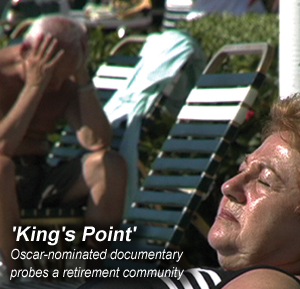
It’s a few weeks before the Academy Awards and Sari Gilman doesn’t yet know what she’ll be wearing — or who. All that Hollywood puffery feels alien to the Oscar-nominated filmmaker.
“Kings Point,” her 2012 film about a sprawling Jewish retirement community in South Florida, is in the running for best documentary short. Not a bad start for someone making her debut as director.
Whether or not she wins the Oscar on Feb. 24, Gilman is more than happy with the film’s reception. It’s been a staple on the festival circuit — including last summer’s San Francisco Jewish Film Festival — and won awards, such as best short documentary at AFI/Discovery Channel’s Silverdocs festival last year.

More than that, the San Francisco filmmaker is gratified her 30-minute documentary about several animated Kings Point residents (some of whom live more happily ever after than others) has triggered a conversation about how America treats its seniors.
Though the flamingo-pink condos and Everglade-green lawns of Kings Point seem exotic, they became old hat to Gilman, 43, a former New Yorker who grew up regularly visiting her grandparents after they moved there in 1978.
“I was always fascinated with the place, even as a girl,” says Gilman. “It was like summer camp for old people. … I always thought it was so cool-looking, with long palm trees and shadows.”
Those shadows had metaphorical meaning, too. As busy as its 15,000 residents kept themselves, no amount of bingo, poolside dances or shuffleboard tournaments could mask the rampant social tensions at Kings Point. Over time, loss and loneliness seemed to reign.
As one resident says in the film, “Everyone’s out for themselves.”
“It’s the American ideal to forge your own independence,” Gilman says. “That generation had been burdened by their parents. It was a badge of honor, of their middle-class status, that they didn’t need to burden their kids.”
Gilman had worked as a film editor on documentaries for A&E, PBS and HBO before casually beginning to bring her camera along on visits to Kings Point. Over time, she found five personable, articulate seniors (all but one Jewish) to focus on. Her widowed, camera-shy grandmother (now deceased), does not appear in the film.
What was it like to transition from the little girl everyone watched grow up, to the serious filmmaker?

Not easy. “Being a documentary filmmaker is like being a professional pain in the butt,” Gilman concedes. “You have to bother people a lot. I parked myself at the pool and started talking to people. I like having deep conversations with people. When push came to shove they needed to talk.”
As Gilman shows, the sociology of Kings Point more closely resembles high school than the nursing home, with gossip about who’s hooking up with whom dominating the mah-jongg conversation. And although “Jewish” is never mentioned in the film, it’s apparent “Kings Point” is a Jewish community.
“Assimilation was very important to them,” Gilman says. “At the same time they liked to be with their peers. This was a generation who only lived among Jews, and when I was there it was 95 to 98 percent Jewish.”
Gilman grew up in the heavily Jewish town of Great Neck, N.Y. She lived and worked in the Bay Area in the 1990s, then returned to her native New York before permanently relocating to San Francisco two years ago.
After the Oscar buzz dies down, Gilman will decide on her next film project. One idea is to interview members of her extended family on the hot-button topic of Israel. Some of her relatives are anti-Zionist, others are settlers in the West Bank, so that should make for some cinematic fireworks.
For now, she’s allowing herself some well-deserved basking, both in her Oscar nod and the film’s impact. “It’s unbelievably satisfying,” Gilman says. “More than anything, I had this feeling about the place I wanted to convey, and ultimately the film achieved the tone I was going for. This isn’t just about Jewish people; it’s about everybody.”