

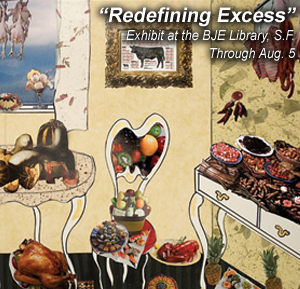
What does it mean to have too much of something? Is decadence wrong, or can it be useful — even holy? Aside from Jewish grandmothers who are forever demanding that we “eat, eat!” because we’re too skinny, what does Judaism have to say about excess?
These questions and others were on the mind of Elayne Grossbard, curator of the Bureau of Jewish Education’s current art exhibit at the Jewish Community Library, when she penned an invitation to local artists.

“When the Israelites brought offerings of gold, silver, incense and sumptuous fabrics to build their wilderness sanctuary, they contributed far more than the skilled craftsmen who fashioned the sacred vessels could use,” she wrote. “Today, these lavish gifts can be understood as a metaphor for those communal obligations that the Talmud declares are without measure, such as acts of lovingkindness: Both embody the Jewish principle of generosity.”
“Artists were asked to ponder an argument that could be made, that Jews are actually commanded to create sacred excess,” explains Grossbard, giving as an example the agricultural practice of gleaning. According to the Torah, farmers were to leave the corners of their fields unharvested, and not attempt to reap any leftovers that had been forgotten after harvesting the majority of a field; the remnants were to be left for the poor.
“I wanted to get at the question of ‘When do we need more than enough?’ ” says Grossbard.
The result is a diverse, dynamic, mixed-media exhibition, “More Than Enough: Redefining Excess,” which opened March 1 and runs through Aug. 5. The pieces, by more than 25 local artists, line the walls and in some cases encroach on the bookshelves at the library, which is housed within the Jewish Community High School of the Bay. One interactive piece by Beth Grossman involves a Warhol-esque tower of soup cans; community members are asked to add to the collection, which will be donated to JFCS’ food pantry.

For San Francisco–based poet Jane Rice, Grossbard’s prompt provided a spark that led to her first participation in a JCL exhibit, though Rice has been a longtime fan and friend of the library. Using scraps of paper — including a postcard of Camille Pissarro’s 1874 painting “The Potato Harvest,” images from the Jewish Historical Museum in Amsterdam by way of a calendar, and fragments of her own book of poetry — Rice created little books of various sizes and colors, printing text from the Torah inside and arranging them in different positions.
A glass case holds a candelabrum made from the books, next to a scene that depicts books as crops and farmers in a field, gleaning. Above them is a shelf on which a dozen slightly larger but still miniature books hang; Rice calls them the “12 Books of Hope.”
“What really got me was the idea that excess can be positive,” says Rice, who previously directed the English-language program at U.C. Berkeley Extension. “And I liked the idea of gleanings — in the sense that there’s always something leftover in so many aspects of life. We only get a portion of whatever we try and learn, for example. And because I’m a poet and I work with words so much, part of the pleasure here was turning away from them, working on something that was about everything but the words. It really liberated my thinking.”

For Jennifer Kaufman, who has exhibited in the library a handful of times, the prompt led her in another direction. Her piece, “Even in the Valley of the Shadow, and Always in Your House, My Cup Is Overflowing,” is both abstract and representational, combining rich blue trapezoidal shapes with graphite and ink lines and other shapes that jut off the paper.
“The first thing that occurred to me was the ‘Dayenu’ song, the concept of ‘It would have been enough,’ ” says the artist, who lives in San Francisco and works at Sinai Memorial Chapel. She added that she remembers taking the song quite literally when she was younger, thinking seriously about what would truly be sufficient to live. She also considered her work at Sinai, as well as translations of Psalm 23, “The Lord is my shepherd, I shall not want.”
“Why is it that at a time of absence, when we are bereft, does God not only fill our cup but make it flow beyond boundaries toward the infinite?” she asked in her artist’s statement.
Other artists interpreted the prompt differently. “Lives of the One Percent: Lunch for Two” by Barbara Millman depicts an ornate room overflowing with enough food for a dozen people; Barbara de Groot used old news clippings to build a timeline of Jews engaged in social activism — drawing a connection between the past and present-day issues of inequality.

At a reception in March, “It was great to see a lot of the artists coming together, finding out how everybody else had responded to the prompt,” said Allison Green, the JCL program coordinator. She and Grossbard played with the theme at the reception, intentionally overfilling the bowls of pretzels and other snacks.
“It’s such a nice mix — some of these artists participate in other shows throughout the year, but this is the only time they focus on Judaism, or have a space to approach Jewish themes with their work,” Green said. “And for some, this is the first show they’ve ever been a part of. It’s a nurturing atmosphere.”
“I hope it makes people think,” said Grossbard of the exhibit. “Even if it makes people stop and contemplate these ideas for even just an hour … that’s a success.”
“More Than Enough: Redefining Excess,” through Aug. 5 at BJE Jewish Community Library, 1835 Ellis St., S.F. Free. [email protected] or (415) 567-3327 ext. 703