

Samantha Abernathey had heard the snippets. Bits and pieces of family lore, told in passing at a seder or some other gathering.
Now, the Novato teen has put the pieces together in her new documentary film “If Streets Could Talk,” in which family members help Abernathey better grasp her history as a Jew in the Bay Area.

Abernathey’s film is one of 11 multimedia works debuting under the aegis of the New Jewish Film Project’s “Half-Remembered Stories.” All the works will premiere Saturday, July 24 at the San Francisco Jewish Film Festival.
“If Streets Could Talk” features Abernathey’s parents, her grandfather, great-aunt and Abernathey herself, taking stock of time spent around various San Francisco neighborhoods. For her grandfather, Sidney Lipton, that meant growing up in the old Jewish pocket around Fillmore and McAllister streets, where you could buy fresh pickles in a barrel.
For her mother, Linda Abernathey, it was her time in the Richmond District during the turbulent 1970s, and for her father, Harvey Abernathey, a North Dakota native who came west as a young man, it was helping to build downtown skyscrapers.
It meant everything to the 17-year-old Marin Academy student to get the whole story.
“A huge part of Judaism is family and another part is telling stories,” says Abernathey. “At every seder and holiday there’s always a story being told. It’s a huge part of my Jewish family life to tell those stories.”

Coaxing the stories out of promising young filmmakers was the mission of Sam Ball, director of Citizen Film and the New Jewish Filmmaking Project. He worked closely with Abernathey and her colleagues.
“We set a bandwidth with half-remembered stories,” Ball says. “We selected that theme because it’s a central premise of being Jewish. There’s a lot of handwringing in the Jewish community about whether this generation will be able to retell our story. What they came up with really surprised me in terms of form and content.”
Ball has been working with young filmmakers since 2002, but says this year he felt the New Jewish Filmmaking Project had reached a turning point.
Digital online media had become too important a part of storytelling to leave out, so his filmmaking project could no longer settle for filmmaking alone.
“Arguably the biggest cultural shift is the rise in digital technology,” he says. “If Jewish culture is to be relevant it needs to be in these interactive spaces, where people spend tremendous amounts of time seeking connections. It’s part of an ongoing debate in independent film: How do we stay relevant? What does it mean to tell a story when people consume stories differently?”

With those questions in mind, Ball and the “Half-Remembered Stories” cohort made sure their works had an online presence. Abernathey’s film, along with photos and text, can be viewed with her colleagues’ works at www.njfp.org.
Her fellow filmmaker, Adam Liss, didn’t make a film at all, preferring instead to create a blog on the theme of half-remembered stories. He calls it “A Zombie Day of Atonement.”
His blog weaves disparate topics such as Torah, the environment, Yom Kippur fasting and zombies (you know: the undead who go around eating brains). The 23-year-old Oakland native and film school graduate can’t say how well the weaving turned out, but he had fun doing it.
“My original plan was to do a blog and a movie,” Liss says. “I did some shooting, and I still might use it, but the whole idea this year was to combine visual media. I started writing and got really into it.”
The zombie theme came about because Liss noticed many friends and acquaintances had been bringing up the concept of zombies as a metaphor for apocalyptic societal disintegration. Somehow he had to square that with the notion of an eternal Torah for the Jews.
 “The whole symbolism of zombies eating you and what that fear represents, there are whole bodies of semischolarly stuff written about it,” he says. “I had this idea to do something about how the Torah was the survival guide of the past.”
While creating their works, Liss, Abernathey and the other storytellers met routinely with Ball and his staff at Citizen Film. Ball says the cohort often taught him more than he taught them.
“We’re on the cusp of some really exciting things,” he says. “That’s something we learned a lot from the young adults in this project. They combined film, graphic design, text, social networking. Their exhibition pieces are the tip of the iceberg.”
That played out well for Abernathey, who is already a digital multitasker.
“I love the art of filmmaking,” she says, “but it was so fun to incorporate all my other artistic endeavors: design all the Web pages, create the home page, take photos and heavily put my fingerprint on everything. That was different for me.”
And fun, apparently, for all of the participants.
“It was inspiring that [everyone] could make something that cool,” says Liss. “It made film seem really accessible.”
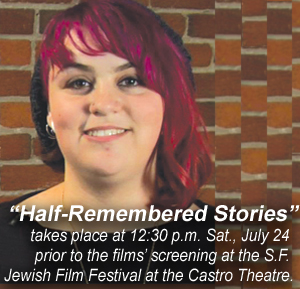
A party for “Half-Remembered Stories” takes place at 12:30 p.m. Saturday, July 24 prior to the films’ screening at the S.F. Jewish Film Festival at the Castro Theatre.
The projects also can be viewed at kiosks in the lobby through Aug. 9. Information: (415) 256-8499 or www.sfjff.org.