

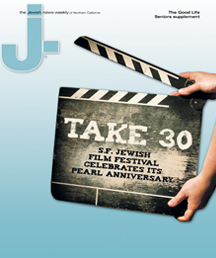
With the 30th San Francisco Jewish Film Festival opening next week, executive director Peter Stein has a paradox on his hands. He wants Bay Area Jews to feel both excited and calm at the same time.
Excited because this year’s festival, which runs July 24 through Aug. 9 at five Bay Area locations, offers a broad palette of Jewish-themed films, panels and special programs. Calm because after a year of turmoil, Stein believes the festival should be able to challenge filmgoers without triggering a battle royal.

Out of 650 films that were submitted, those that made the final cut do cover a lot of ground. With themes such as Jewish gangsters, Jewish baseball players and Jews with disabilities on the bill, Stein thinks he has the right cinematic mix to lure audiences.
“Our goal is to maintain civil engagement and pride in the films we show and the topics they address,” Stein says. “We have great faith in the community to rise to our better selves.”
With the controversy over the 2009 screening of the documentary “Rachel” fading, Stein and his colleagues have made changes in terms of outreach to the broader Jewish community.
These include a new outreach committee, formed last fall and composed of eight local Jewish leaders who serve as advisors to the festival board to make sure the broader community understands the festival’s programming policies.

In addition, the festival no longer enlists organizations to co-present individual films. Last year, having Jewish Voice for Peace and the American Friends Service Committee (organizations some consider anti-Israel) co-present “Rachel” sparked additional controversy.
And one new event on this year’s schedule is a free, lunchtime panel titled “Is Dialogue Possible? How Films Help Us Talk About Israel (… Or Not)” — clearly an outgrowth of last year’s “Rachel” fallout.
But Stein and program director Jay Rosenblatt much prefer talking about the 57 films in this year’s festival to rehashing the past.
“This being our 30th anniversary, we wanted to bring a celebratory energy to the festival,” says Rosenblatt. “It already has that, but we wanted to up it a bit more.”
For him that starts with the opening night feature, “Saviors in the Night,” a Holocaust-era true story about a non-Jewish German family that hides a Jewish woman and her daughter. Marga Spiegel, the 98-year-old real-life mother, will be coming to San Francisco to attend the screening, along with the director and two of the film’s stars.
This year’s centerpiece film, “Anita,” is a 2009 drama from Argentina that stars Alejandra Manzo as a young Jewish woman with Down syndrome. Separated from her mother at a pivotal moment in the history of the Buenos Aires Jewish community, the title character goes on a poignant search.
“It’s an incredibly delightful, moving, emotional film,” Stein says. “It’s unique in that [Manzo] has Down syndrome and she is wonderful in this film. It was one of the first films I said there’s no question this is in the festival.”
Then there is “Hungry Hearts,” a 1922 silent film about the Lower East Side, which will be screened with a newly written, full-length score by local composer–rock musician Ethan Miller, who will perform it along with his band.

Stein notes, “It’s an immigrant story based on short stories of a woman writer, Anzia Yezierska, who became known in Hollywood as the ‘Sweatshop Cinderella’ for her rags to riches stories of Jewish women making it in the New World. It was produced by Samuel Goldwyn and meant to be an early presentation of Jewish American life.”
The festival received a grant from the Columbia Foundation to commission the Miller score, which draws on psychedelic music even more than it does Yiddish strains.
“The experience of hearing live music with a film is fantastic,” Stein adds. “Folks who love silent Yiddish melodramas will come for the film. Others who are excited about [Miller] will come to hear the music.”
That’s not the only music to be heard at this year’s festival. The closing night film, “The Klezmatics: On Holy Ground,” is a documentary about the pioneering New York–based klezmer band. Some band members, along with director Erik Greenberg Anjou, will be in attendance, and just might be carrying instruments with them.
 As they do every year, festival organizers have come up with some appealing themes around which to bundle films. This year’s most prominent is “Tough Guys: Images of Jewish Gangsters in Film,” a series curated by former SFJFF program director Nancy Fishman.
Titles set for screening include 1991’s “Bugsy” (starring Warren Beatty), the original 1932 version of “Scarface” and “Lepke,” a 1975 film starring Tony Curtis as mobster Louis Lepke.
Stein says the gangster films “touch on issues of masculinity and Jewish power.”
“As for Jews and Baseball: an American Love Story,” narrated by Jewish Academy Award winner Dustin Hoffman, the 91-minute film covers the chosen batsmen, from Hank Greenberg to Kevin Youkilis. For Rosenblatt, this 2010 film is a festival highlight.
“Jews are not always associated with athletic prowess,” he says, “but it’s remarkable how many Jews were successful in that sport. I felt extremely prideful [watching it]. It brought me back to childhood, growing up in Brooklyn and being into baseball.”
Stein and Rosenblatt have not shied away from programming films that deal with the Israeli-Palestinian conflict.
Two of the most prominent this year are “Budrus,” a documentary about the Israeli security barrier cutting through an Arab village, and “My So-Called Enemy,” which follows two groups of young women –– Arabs and Israeli Jews –– over a period of seven years, from their meeting at a dialogue conference and their diverging lives afterward.
“You see how this momentous coming together did shift these women’s ideas about what it meant to grow up a Jew or Arab in Israel and the West Bank,” Stein says. “The fact that they are women of a generation that doesn’t want to engage in hate makes this a very moving film.”
The festival’s Freedom of Expression Award this year goes to Sayed Kashua, an Israeli Arab author, satirist and creator of the popular Israeli TV sitcom, “Arab Labor.” The show skewers everyone in Israeli society, Arab and Jew.
Because he has chosen to write in Hebrew, rather than his native Arabic, Kashua “is not beloved in the Arab world,” Stein says. “But they watch the show. He’s the court jester, the fool who points out the truth.”
The festival will screen several episodes from the show’s current season, and Kashua will be in San Francisco to accept his award.
The reputation of Kashua’s show preceded its entry into the festival, but many of the offerings are relatively unknown entities that Stein and Rosenblatt find by attending film festivals like Sundance and Berlin. Others make their way to the SFJFF via submission, and are then reviewed by a team of screeners.
“Every film is seen by at least two sets of eyes,” says Rosenblatt. “If the rating is at a certain level, it comes to us. For me the main focus is on quality of work. That would be any film, whether dealing with the [Israeli-Palestinian] conflict or other sensitive issues. That’s not to say there wasn’t a certain affect from last year in terms of how we thought about films. If we were going to show something with controversy, we wanted to make sure it was a successful screening.”
Rosenblatt knew he had a tough act to follow after former program director Fishman departed last year. As a filmmaker who has had his work exhibited in previous festivals, he brought a new skill set to the table.
With more than 25 films to his credit, and as a writer, director and film professor, Rosenblatt has earned numerous awards. His work has screened at the Sundance Film Festival and has aired on HBO and the Independent Film Channel, not to mention the San Francisco Jewish Film Festival.
Stein says that because the San Francisco resident already had a familiarity with the festival, Rosenblatt didn’t have to start from square one.
“The reason I asked Jay to take on the position is I admire his film sensibility,” Stein says. “Not only do I respect his filmmaking, but his critical sensibility. He’s a very fine teacher, so I had a sense he’d bring an extremely high level of finesse and expertise.”
Rosenblatt adds, “I knew I was filling big shoes with Nancy Fishman having done it so well. Sometimes I introduce myself as the new Nancy. I approached it in some ways as I approach a film: attention to detail and a critical eye, not wanting to compromise on the vision.”
Rosenblatt had not yet come aboard when the “Rachel” controversy broke last year. He says it was a net-positive for the festival to join the staff as an outsider uninfluenced by the uproar.
In the wake of that uproar, Stein and the festival board determined to improve community contact well before this year’s festival got under way. Stein met with the local Anti-Defamation League and the S.F.-based Jewish Community Federation, and created the outreach committee to make sure no programming effort would be seen as “somehow willingly lighting a match in a room of flammable gas.”
He says the festival’s relationship with the federation — which took heat for providing some $80,000 in festival funding last year –– remains strong. Earlier this year, the federation issued guidelines to make sure grantees did not promote stridently anti-Israel positions, or provide a forum for those who do.
Stein has said the festival will abide by those guidelines.
“It’s a relationship we’re very proud of,” Stein says. “I think the federation is eager to indicate that an organization with as robust a take on Jewish life as the festival should be a federation agency. I sympathize with the difficult position they were put in, having to draw a line between what is appropriate and inappropriate to fund. It’s going to part of a long ongoing conversation.”
As the impresario of the festival, Stein prefers to stay positive and leave l’affaire “Rachel” behind him. He feels with a 29-year track record of entertaining and delighting Bay Area audiences, the festival has earned that.
“Last year our festival was hijacked by one film, which was a real shame,” he says. “But this is year 30 of a really extraordinary institution. What I feel most proud of, we continue to invent and reflect Jewish identity not just in the Bay Area, but throughout the world.”
The 30th annual San Francisco Jewish Film Festival runs from July 24 through Aug. 9, with films being shown at five theaters in four cities.
The 88-year-old Castro Theatre in San Francisco serves as the anchor cinema from opening night through Aug. 3. Other sites include Cinearts @ Palo Alto Square (July 31-Aug. 3), the Roda Theater at the Berkeley Repertory (July 31-Aug. 7), the Smith Rafael Film Center in San Rafael (Aug. 7-9) and the JCC in San Francisco (Aug. 7-8).
For a full schedule, descriptions of films and events, tickets and other information, visit www.sfjff.org. Tickets can also be purchased by calling (415) 256-8499.
RELATED: Opening up with a riveting tale of survival
RELATED: Gandhi, MLK … and a Palestinian movement in ‘Budrus’