
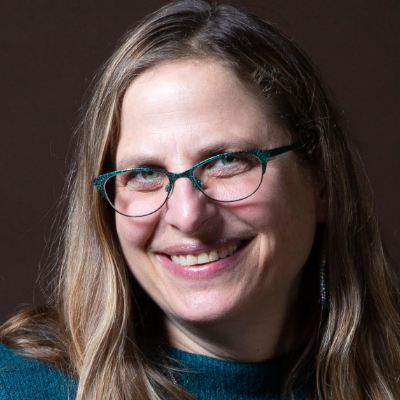
At a housewarming party a year ago, Sarah F. started talking to a woman who looked familiar.
Sarah had almost skipped the event — chemotherapy was draining her energy.
“When I told [the woman] my name, she said, ‘That sounds really familiar. Where do I know you from?'” Sarah recalled.
Suddenly, it dawned on the woman: “I know. We’ve been praying for you in my Rosh Chodesh group.”
Sarah burst into tears.
This High Holy Day season, which falls during Breast Cancer Awareness Month, the Alameda resident is in a much happier place than she was then. She is cancer-free.
In 2004, after being diagnosed with breast cancer at age 36, Sarah’s focus — which had been consumed with a high-stress job as an assistant middle school principal, writing her Ph.D. thesis, hanging out with friends, and dating — took a dramatic turn. She could deal with one thing and one thing only: surviving.
Not only did she have four tumors in her breast but the cancer had spread to her lymph nodes as well. By last year’s High Holy Days, she was bald and nauseated much of the time.
She found the Yom Kippur service nearly impossible to sit through. “It’s about who’s going to live and who’s going to die, who by stoning and who by fire — and who by breast cancer,” she said.
Sarah is an Ashkenazi Jewish woman who until her diagnosis had no idea she was considered a high risk for breast cancer. She was also susceptible because she is the daughter of a breast-cancer survivor (though, since her mother was diagnosed after menopause, that fact kept Sarah from being at a still higher risk).
In the last decade, researchers have confirmed that two gene mutations increase the chances of a woman developing breast or ovarian cancer, genes that have a higher rate of occurrence among Ashkenazis.
And in some especially high-risk locations, such as Marin County and Long Island, N.Y. — where there are large Jewish populations — the rates can be as high as 1 in 7 women who will get breast cancer.
Last spring, Sarah was a mere two weeks away from the oral defense of her doctoral thesis in education at Mills College. She discovered something that felt like a marble near her armpit while showering.
She saw a doctor, who recommended a mammogram. That test — which she, as a healthy thirtysomething woman, had never had before — detected nothing.
That, unfortunately, is not unusual.
In their mid-30s, many women’s breasts are dense with numerous benign lumps, a situation that can mask malignancy.
When Sarah — whose story is fairly typical — told her retired-pathologist father that she still felt it, he encouraged her to have an ultrasound.
The radiologist said not to worry — it was probably just an enlarged sweat gland.
Even when they found four tumors, medical personnel gave Sarah the feeling that the growths were benign.
Two days later she had a biopsy — and, before the results came in, defended her dissertation.
The following Monday, everything changed. A doctor uttered words Sarah was totally unprepared for: “You have cancer.”
“I looked at her like she was crazy, like ‘What do you mean, I have cancer?'”
Sarah tears up as she recalls the moment. She tears up numerous times, in fact, as she recounts her long journey back to wellness.
She remembers leaving the doctor’s office in a daze, but not before scheduling countless tests.
She remembers calling her Boston-based father, who assured her he would get the names of “the best people” in the Bay Area.
Miraculously, because of a cancellation, she managed to get an appointment almost immediately. She retrieved her films from Alta Bates in Berkeley, and arrived at U.C. San Francisco at 5 p.m. By 6 she was undergoing a fine-needle biopsy, and by 6:30 a doctor was telling her the results.
She not only had four cancerous tumors — one of which was considered quite large, at 2 centimeters — but the cancer was in 3 of her lymph nodes.
The physicians scheduled more tests, to see if the disease had spread even farther. Luckily, it hadn’t.
A genetics counselor came by. She told the new patient about the gene mutations, and urged her to be tested. “Her demeanor was lovely, really sweet,” Sarah remembers, “but here I am, overwhelmed by the discussion of surgery, chemotherapy, radiation, and she’s telling me I should have my ovaries removed.”
According to literature from Sharsheret, a Teaneck, N.J.-based organization, one in 40 Jewish women of Ashkenazi descent carries the BRCA1 or BRCA2 genes (compared to 1 in 345 women in the general population).
There may be as high as an 82 percent chance that someone who carries an altered gene will develop breast cancer by age 70.
When Sarah absorbed the gene data, and also learned that many women raise their risk of breast cancer by delaying having children, she sent a red-flag e-mail to Jewish friends who “have not had kids yet,” urging each of them “to do regular self-checks.”
Sarah’s oncologist later developed a theory that she had had a slow-growing form of cancer that had been in her body roughly eight years.
Eight years before, Sarah had been spending long hours in her job as a teacher in Bayview/Hunter’s Point, widely known as the most polluted area in San Francisco.
Meanwhile, the geneticist kept pushing her to have her ovaries removed.
“I’m single and 36 and thought that when I finished my dissertation, I still had plenty of time to find a guy, get married, have a family and have the rest of my life,” remembers Sarah. “And this door is being closed before I get a chance to walk through it.”
Ultimately, she decided to be tested for the gene. She was negative, which spared her older sister the difficult decision of being tested.
Her chemotherapy treatments began right away, in an attempt to shrink the tumors. The unpleasantness of those treatments was magnified by the difficulty nurses had in locating a good vein. They found it necessary to poke her numerous times.
Her doctors recommended she have a port installed in her chest so the chemo drugs could be directly administered that way rather than intravenously.
Another problem: Her hair began to fall out from the chemo. “It came out in bucketfuls, all over my pillow, in the shower, in the car. I started every day crying because it kept coming out in the shower.”
Her parents were visiting, and when she and her father were out, they passed a hair salon. She told him to pull over. “He asked, ‘Are you sure you don’t want to wait?’ But it was absolutely what I needed to do,” she remembers.
As Sarah’s head was shaved, she could see her seated father’s reflection in the mirror. Rather than watch, he slumped over, holding his head in his hands.
Psychologically, Sarah herself slumped over when it came to learning about survival rates for women in her situation. She really didn’t want to know. “The genetics woman was the one who liked to give me statistics, and I did my best to ignore it. I didn’t like the information she was telling me. I didn’t want to know the chances.”
She remembers exactly how tough the treatments were.
“I didn’t know just how hard it would be to get through nine months of [them]. I underestimated what it means to really be sick. It was so much harder than I thought.”
During her chemo, Sarah worked as much as she could, but barely went out otherwise. But she found herself surrounded by helpful people. Her friends were a great support, but then there were the people she didn’t know that well. Many of them she knew through Chochmat HaLev, where she was a regular, and Kehillah Community Synagogue, where she occasionally attended.
They cooked for her and offered to shop. “I really felt the support,” she notes.
The housewarming party incident led to her visiting the Rosh Chodesh group in which her friend, Devorah Levy, had offered up Sarah’s name for prayer each full moon.
When Sarah attended, the women put her in the center of a circle, lay their hands on her and blessed her.
Remembers Sarah, “I felt so blessed. I didn’t know these people very well, some of them not at all. What an amazing gift to receive from them. I continually felt this incredible generosity and kindness from strangers, and I’m still so thankful for that. I know it helped me to get through this.”
People of other faiths prayed for her as well.
A former co-worker and her husband, devout Catholics, prayed for her every Sunday. The “husband put on one of those yellow bracelets and said he wouldn’t take it off until I was healed.”
Sarah remembers that she “didn’t discriminate. I took the blessings wherever they came, and I really believe they helped.”
By late summer, she began a new drug regimen, one that made her even sicker. She lost her eyebrows, eyelashes and toenails. She had a horrible tingling sensation in her feet. Then she came down with thrush, which made her tongue swell up “the size of a kitchen sponge.”
The good news came after that cycle of treatment. Her tumors had shrunk significantly — in fact, only 20 percent of such tumors shrink as much as did hers.
She now had to weigh the unpleasant choice of mastectomy (removal of the breast) versus lumpectomy (removal of the tumors and surrounding tissue) plus radiation.
“You imagine being back on the dating scene and trying to figure out issues of body image,” she said. “In the cancer journey, it’s about surviving. One side of you is like, ‘Yeah, take the breast if I’m going to live,’ while the vain side of you is worrying about [what happens] when life is ‘back to normal.'”
Sarah had a lumpectomy on Election Day, Nov. 2004. (Morphine made it easier to digest the news of John Kerry’s defeat in the presidential race, she joked.)
When it was over, she was greatly relieved that her breasts seemed the same size. And that the surgical scar was minimal.
But then came two months of radiation, five days a week.
Finally, in February of this year, Sarah’s doctors started her on Tamoxifen, a drug frequently given pre-menopausal breast-cancer survivors. She will be on it for the next five years, during which time she cannot get pregnant (the drug is known to harm embryos).
When she gets off Tamoxifen, she will be 43. She has made peace with not bearing children. “At first, I was really sad about [it], and thought why didn’t I do it five years ago. Yet I’ve always felt it was more important to find the right partner first.”
Sarah is open to adoption. But still, “When someone says you can’t have something, it makes you want it more.”
She is glad, however, that she doesn’t have to negotiate the dating world again. She is happily involved with someone she met while sick.
“He didn’t run the other way,” she says. “He has Crohn’s disease, so he gets what it is to have an illness.”
As many survivors do, she has altered her lifestyle in major ways.
For one thing, she has chosen to take a lower-stress job.
The disease and treatments “really slowed me down,” she relates. “It was like someone took a ton of bricks and said you’re going to stop dead in your tracks.”
Sarah now spends more time alone, because she gets tired more frequently than before. She has found working in her garden extremely nurturing.
She can’t read as fast as she once did, and her concentration is diminished as well — conditions some survivors call “chemo brain.”
Some experts say it could be at least two years before her former abilities return completely, if they do.
“Some of this has been about learning how to be OK with sadness, and learning how to go to the depths of those emotions and not to be afraid,” says Sarah.
And because of the lymph node removal, she will have to wear a medical sleeve when she flies or is at a high altitude. She also doesn’t know whether she will be able to backpack or kayak anymore, two activities she loved.
“In the grand scheme of things,” she said, “it’s a minor inconvenience.”
Sarah had joined two support groups, and while she doesn’t go as much now, she still sees one woman she became particularly close with — a patient who finished treatment only to have the cancer return almost immediately.
“The fear is always there that it will come back,” says Sarah. Still, “it’s not something you can spend every day worrying about. You’d go crazy if you do.”
Every now and then she ponders “why this happened, and what am I supposed to be learning. But I also know it’s not my time to go — it’s clear that I have a lot more to do on this planet.”
Related Stories:
A chemotherapy siddur – and other Jewish Resources
Jewish men throw a party for breast-cancer research