
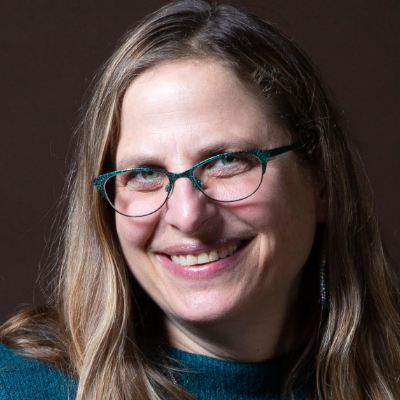
When one of Chana Andler’s sons had a bar mitzvah, she could have given him a tallit to mark his passage to adulthood.
But she came up with a different kind of ritual, rather than embarrass her son on the bimah, like so many parents do, with their gushy remarks.
“This is not about me with my kid,” she said. “This is about his relationship with his community.”
So rather, Andler had nine adults from her congregation form a circle. Andler and her husband passed the tallit to the first person, who blessed it, and then passed it to the next. The tallit was passed around the circle, until it was blessed by everyone, and then the ninth person handed it over to the bar mitzvah boy. He stepped into the spot in the circle, becoming the 10th adult man to complete the minyan.
Andler, a Berkeley resident who does communications and marketing for the S.F.-based Jewish Family and Children’s Services, is also a teacher and Jewish educator. Through her years of participating in a Rosh Chodesh group, mothering, and now grandmothering, she has come up with numerous rituals to enhance the holidays and make them more meaningful for her family.
She shared this in a workshop called “Developing Innovative Family Rituals” at the daylong conference, “Jewish Women and Spirituality” on Sunday, July 10. Though the conference was sponsored by Chochmat HaLev, the Jewish meditation center in Berkeley, it was held at San Francisco’s Congregation Emanu-El and brought together several hundred women from many different congregations in the Bay Area.
While Andler’s description of the bar mitzvah ritual had some of the women attendees choking up with emotion, not all rituals have to be so well-thought out, nor serious, she said.
While many Jewish families do follow the Omer, the practice of counting the days between the second night of Passover and the day before Shavuot, there is an easy way to make children understand why we observe this seven-week period between redemption from slavery and the giving of the Torah.
Andler used to drop a jellybean in a jar each night of the Omer, and then on Shavuot, the children would eat all the jellybeans.
While it takes creativity and imagination to come up with such rituals, Andler said, giving yourself permission to do so is equally important. Many people have the idea that these rituals are somehow set in stone and not to be adapted in any way.
“It’s important to tell yourself, ‘I don’t need permission to adapt this,'” Andler said.
Andler also made the point that it is incumbent upon parents to practice rituals at home and not expect that Jewish children will get everything they need from religious school.
“It’s not the synagogue nor Hebrew school’s obligation to teach my children, but mine,” she said. “The prayer says teach your children, not shlep them to somewhere else to teach them.”
Another example she gave of a family tradition was doing community service on Tisha B’Av, a day that mourns the destruction of the First and Second temples.
“We read the book of Lamentations as a family and then talked about how the Jews suffered, but also about how others are suffering,” she said. “Doing community service together teaches that we’re not immobilized by our grief.”
She also emphasized how important food is to Jewish tradition.
“If you don’t know how to cook, learn,” she said. “Food is the Jewish way. Food accomplishes all the things good ritual does. My kids could know which holiday it was because of what food was on the table.”
Andler said that her husband calls her “Martha Stewart Schwartz,” adding that “I was doing Martha Stewart before she was Martha Stewart.”