
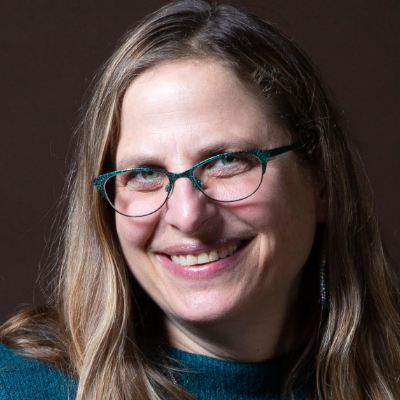
Galeet Dardashti’s grandfather was such a highly regarded classical singer in Iran that many Muslims would come to synagogue just to hear him sing. He also sang numerous times for the Shah in his palace.
When Dardashti was a little girl, she performed Jewish music with her parents and two sisters. A family act, they called themselves “A Dash of Dardashti,” she says with a laugh.
Her father, though raised singing Mizrachi music, is a cantor at an Ashkenazi synagogue. Her mother is also a musician.
They performed at Jewish music festivals and Jewish venues, and of course, elderly homes, too.
“That was our training ground, it started as a good deed, and then suddenly, we were performers,” said Dardashti. “I totally have my parents to thank that I feel so comfortable on stage.”
Dardashti, who fronts the four-women band Divahn, will perform Thursday, July 14 at Café du Nord in San Francisco — a concert sponsored by New Generations of the New Israel Fund and numerous other organizations.
“Divahn” means a collection of songs or poetry in Hebrew, Arabic and Persian.
Dardashti is not only a performer, but an ethnomusicologist. While studying anthropology at the University of Texas, she was drawn to studying Persian classical music, because of her family history.
“It was a research topic first,” she said. “I realized how much of a musical connection there was between Arabs and Jews, and how integral Jews were to making music in the Middle East. I’m an anthropologist so I’m constantly thinking about politics, but I also just really fell in love with the music, and wanted to share the message of this shared culture between Jews and Muslims.”
And being in Austin, Texas, a home for experimental music and music aficionados of all sorts, it was the perfect breeding ground for a band playing Mizrachi rhythms.
The band came together in 2001, in Austin, playing their own interpretations of Mizrachi sacred and secular music.
“Austin was the best place for a band playing Jewish music,” said Dardashti. The high-tech community had brought an influx of Jews, and unlike other metropolitan areas, there were limited Jewish activities, so people were drawn to their performances.
But at the same time, they attracted a large non-Jewish following as well.
“People were so appreciative of our music and our message, even if they didn’t understand the words,” she said. “They were really attracted to the fact that we were sharing this, and most didn’t know there was Jewish music like this.”
She never intended for Divahn to be an all-women band, but Dardashti soon realized why it should be so: In traditional Mizrachi culture, women are not allowed to sing in front of men.
“People were really moved because they hadn’t seen sacred Mizrachi music sung by women,” she said. “I was used to participating because I grew up in an Ashkenazi synagogue, but other women don’t have that kind of participation.”
Dardashti is still completing a Ph.D. on Mizrachi music in Israel, and last year spent a year there on a Fulbright grant doing research. She has seen how Mizrachim are now taking more pride in their heritage, after years of discrimination.
Dardashti has studied piyutim, the sacred prayers sung by Mizrachim that women were never allowed to chant.
“Sacred music has made a major revival in Israel. All of these secular Ashkenazis are signing up for these classes, to learn sacred Mizrachi music.”
Divahn will perform Thursday, July 14 at Café Du Nord, 2170 Market St., S.F. Doors open at 7:30 p.m. Opening act Amy Tobin performs at 8:30 p.m. $12 in advance, $15 at the door. www.cafedunord.com.