
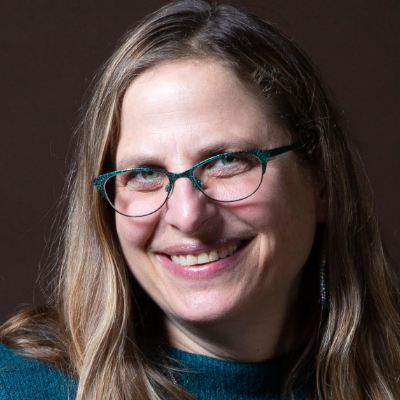
Gila Svirsky spent her junior year of college in Israel. It was 1967, and being there during the Six-Day War had a profound effect on her.
“It was my first war, and a very successful one at that,” she said during a recent visit to the Bay Area. “I knew I was going to stay.”
Svirsky and two Palestinian women — a Muslim and a Christian — spoke at San Francisco’s World Affairs Council of Northern California, U.C. Berkeley and Stanford University about their experiences and visions for a shared homeland. The tour was sponsored by the Washington, D.C.-based Partners for Peace.
After her year in Israel, Svirsky returned to Brandeis University in Waltham, Mass., to complete her degree. Then she made aliyah. “I felt very strongly that as a Jew, this is my homeland,” she said.
She was Orthodox and 19 then; today she is 58 and no longer Orthodox. But one thing hasn’t changed, she said: “Today I feel exactly the same way, this whole ‘peace activist’ bit is trying to get back to the original Zionist vision.”
Why did she agree to go on a speaking tour with two Palestinian women she had not met beforehand? How could she know she’d be comfortable sharing a stage with them?
“I was a little worried,” she said. “I didn’t know who the women were, and worried about their politics — that they might be people who don’t believe that Israel has the right to a state, and I gave it a lot of thought.” But she decided to take her chances.
As it turns out, Marianne Albina and Hidaya Said Najmi were “both deeply invested in compromise and sharing the land. They both shun violence as a strategy,” Svirsky said.
And while at times it was a bit uncomfortable — they didn’t agree on everything, after all — Svirsky said that the tour no doubt has been harder on Najmi, who is from Jenin in the West Bank. Though she made clear that she didn’t feel comfortable speaking for the two other women on the tour, Svirsky did say that she is the first Israeli Jew that Najmi has ever met.
Svirsky agreed to come on a speaking tour of the United States with the two women, not only to be a pro-Israel voice, but because she felt strongly that both Americans and American Jews have a major role to play in the region.
“If you’re really pro-Israel, you’ll try to help us figure out how to end the occupation, because it’s bad for Israel, too,” she said.
Svirsky still calls herself a Zionist, even though she believes that the Israel she lives in is a far cry from how its founders envisioned it.
In these difficult times, Svirsky hardly does anything that isn’t related to the conflict. She is involved with Women in Black, a human rights organization, and Bat Shalom, the women’s peace organization. Lately, she’s been spending most of her days either conducting “reality tours” for Israeli Jews, in which they visit refugee camps and checkpoints, or showing solidarity with Palestinian farmers by helping them harvest their olives. Often the farmers are prone to attacks by settlers.
And for the first time in 38 years, she registered to vote in the presidential election.
“I feel I have the right to vote in the U.S. because the president has so much influence on my life in Israel,” she said in October. “Whoever is president should not be someone who gives blanket support to Israel, but tries to figure out what it would take to get both sides to agree to a political accommodation.”
She believes that neither Arafat nor Sharon has been capable of making peace.
Noting that 69 percent of Israelis say they want to get out of the territories, she said, “I want to tell American Jews that Israelis are not as vengeful as our prime minister and not as eager to perpetuate the conflict. We’re fed up with it and trying to figure out how to get to peace, and for that to happen, the U.S. government needs to play a more active and balanced role than it has.”