
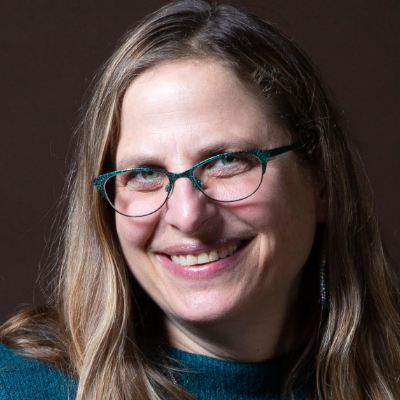
Bernice and Helene Krinitz grew up hearing their mother Esther’s stories. They heard about happy times, about her and her younger siblings growing up in a small Polish village. And they heard about the difficult times, when their mother and her younger sister posed as Catholic farm girls, constantly on the run, to avoid being sent to a concentration camp.
Their mother and her sister were the only ones in their family to survive the Holocaust. They fled the village the same day that the Nazis came to ship the Jews off to a concentration camp.
Seeking a way to preserve those memories, Esther Krinitz — a trained dressmaker — began documenting her story of survival for her daughters in the way she knew how: with fabric and thread.
Now her daughters are attempting to bring the stories of their mother, who died in 2000 at the age of 74, to a wider audience. They will be sharing her artwork at a Yom HaShoah event at St. Gregory of Nyssa Episcopal Church, co-sponsored by Congregation Sherith Israel.
“We were looking for artwork and discovered Esther’s work, and it was such a perfect fit,” said Suzanne Fowler Palmer, the art editor of God’s Friends, the church’s journal, which is devoting an issue to the power of narrative.
Inviting Sherith Israel to cosponsor the presentation made for a good interfaith event, Fowler added.
Esther Nisenthal Krinitz did not start recording her stories on fabric but she “always wanted to communicate it in some way,” said her daughter Bernice Steinhardt. “She thought that she ought to write it down.”
Although she kept notebooks, she wanted to share with her daughters what her home and family had looked like. But she had no photographs.
So she sketched a picture of her home and then began to fill in the sketch with patchwork and embroidery.
Krinitz “had always been incredibly clever with her hands,” said Steinhardt. “She could sew anything, and always made our clothes. She was always knitting or crocheting or something.”
But shortly after, grandchildren were born, and Krinitz directed all of her sewing energies toward them.
About 10 years later, Krinitz began having recurring dreams of the war, especially of the day she said goodbye to her parents and siblings for the last time. So she began to sew her memories again. After her first two panels, she began to stitch captions at the bottom, allowing the viewer to “hear,” in her own words, exactly what took place.
Krinitz’s work is not easy to categorize. Sometimes described as folk art, it also has been called tapestries, “but it’s technically not,” said Steinhardt, speaking from her home in Chevy Chase, Md. “It’s textile art.”
Steinhardt said that it is somewhat similar to quilting, in terms of preserving family memories, but quilting does not usually include narrative.
And unlike the familiar photographs of the Holocaust, all in black and white, Krinitz’s depictions are in vivid color.
“They have a great deal of eye appeal,” said Steinhardt. “It’s not until you are drawn into them, and then read the caption to understand the story, that you are gripped by the contrast.”
While the panels have been shown at a Jewish community center in Washington, D.C., and some are at the American Visionary Art Museum in Baltimore, the daughters want to bring them to a wider audience through the Art and Remembrance Foundation. (www.artandremembrance.org)
“An Evening of Story and Remembrance: The Art of Esther Nisenthal Krinitz” will feature video, photographs, artwork and personal testimony with Krinitz’ daughters, light refreshments and klezmer music by Kugelplex. 7:30 p.m., Saturday, April 17, at St. Gregory’s Church, 500 DeHaro St., S.F. $12 adults, $8 students/seniors. To pre-register, call (415) 255-8100, ext. 29, or go to www.godsfriends.org.