
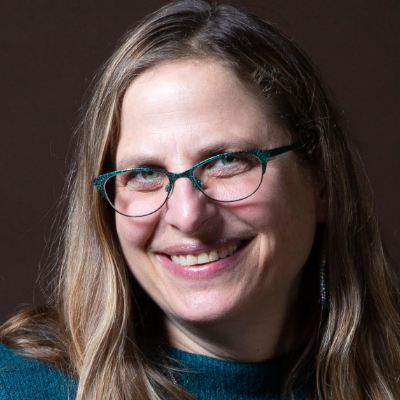
Six years ago, Tsiporah Gabai took daughter Shiri to Afikomen in Berkeley to select a tallit for her upcoming bat mitzvah.
While looking over the many prayer shawls, Shiri asked her mom, “Why don’t you get one too?” She even offered to use her own bat mitzvah money to pay for it.
Gabai thought it over. From the age of 6, she wanted to be a rabbi. But in her Orthodox world, women didn’t do such things. Studying Torah was something she did, almost unconsciously, but the conscious act of donning the ritual garment intended for men was unthinkable.
Finally, she told her daughter: “I’ll make you a deal. I’ll buy one, but you can’t pressure me to wear it. I’ll only wear it when I’m a rabbi.”
Shiri had heard her mother talk before about becoming a rabbi. “Are you really going to do it?” she asked.
“You know it’s my dream,” her mother answered.
The dream survived, but the tallit — its borders decorated in navy blue, turquoise and gold — sat packed away in a drawer, forgotten for six years.
Last week, Gabai finally opened the drawer. Later that day, as she unfolded the forgotten tallit for the first time, two visitors to whom she was telling the story got the chills. The price tag was still attached.
Then, saying a Shehechiyanu — the prayer recited when something happens for the first time — Rabbi Tsiporah Gabai wrapped herself in the prayer shawl.
At 45, Gabai, the assistant director of Tehiyah Day School in El Cerrito, was ordained last month in Los Angeles. She believes she is the only woman in the world of Moroccan heritage to be ordained as a rabbi.
Gabai, whom everyone calls Tsipi, has an energy and a presence that belies her 5-foot stature (“and a quarter-inch,” she emphasizes).
Her eyes are huge, and she speaks at a rapid pace with an Israeli accent, interspersing her remarks with occasional words or sentences in her native Hebrew.
She completed her studies in three years, commuting weekly to the Academy of Jewish Religion in Los Angeles, while keeping her full-time job at Tehiyah.
AJR, a New York-based seminary with a branch in Los Angeles, is not connected to a particular movement. The institution has faculty members from all Jewish streams, which is why Gabai chose it. Though she herself belongs to the Conservative Congregation Netivot Shalom in Berkeley, she prefers to identify simply as “Jewish.”
At Tehiyah, she wears a white and gold knit kippah over her short brown hair. She calls everyone “Sweetie.” And in true rabbinic fashion, she often likes to answer a question by telling a story.
A divorced, single mother with three children of her own — her children are now 23, 21 and 18 — Gabai was born and raised in Israel, where she was the youngest of nine. The family lived in Ma’a’lot, where her Moroccan-born father, the late Yosef Gabai, served as the chief Sephardic rabbi of northern Israel. The family is descended from a rabbinical dynasty that dates back to 1492. In fact, the surname itself means “synagogue official.” Synagogues in both Ma’alot and Jerusalem are named after Yosef. Gabai has an older brother and seven nephews who are rabbis in Israel.
Yet when she was growing up, she was not allowed to touch the Torah. “I always wanted to be like him,” she said, showing a picture of her father, a dignified man with a white beard, in one of his books. “When I was 6, I told him, ‘I want to be just like you, I want to be a rabbi.'”
The rabbi told his daughter, “I’m sure you’d make a great rabbi, but it’s impossible.”
But even then, the 6-year-old Tsipi got it in her head that that’s what she wanted to do.
Gabai described her home as one where the door was always open to all who wanted to come. Shabbat meals usually served no less than 25. Students came from far and wide to study with her father. They’d often do so in their book-lined living room, where the young Tsipi was allowed to listen in — but only on the condition that she not butt in with the answers even when she knew them — which was often.
While her father would teach Talmud to Tsipi along with her brother, when it came to learning how to chant the Torah trope, he always said no.
“Zeh lo fair!” she’d cry (“It’s not fair”). “I want to chant from the Torah!”
“He would say he was also sad, since I had such a nice voice, but that’s halachah,” Jewish law, she said.
Today she believes that although it would have been difficult for him to accept her new career, deep in his heart he would understand and be proud of her.
As for her mother, who died more recently, Gabai calls her “the shining star of my life.” Her mother imparted the wisdom that she has passed onto her own children, as well as her children at Tehiyah, where she has served as acting spiritual leader for many years.
Her mother’s advice: “You can be anything you want, but be a mensch first. Follow your heart, and be good to people. Being a good human being comes before your Ph.D.”
There were times when getting up at the crack of dawn on a Sunday morning to fly to Los Angeles seemed inconceivable. But Gabai could see her mother standing there, holding her plane ticket in hand, saying, “Come on, why aren’t you going? You’re not alone, just do it!”
While Gabai speaks reverently about her parents and lovingly about her children, she is a bit less effusive about her siblings. All eight of them still adhere to the traditions in which they were raised, and they all remain in Israel. Her new title is something they know about but do not discuss, and she doesn’t flaunt it.
“I can understand them because I come from that world,” she said. None of them came to her ordination, and when asked whether even one had extended a simple mazal tov, she shook her head no. For the only time during an interview of several hours, her voice quieted and she seemed to stop moving. She described their collective reaction as more of, “That’s nice, now let’s move on.”
But her family and friends here made up for that on a grand scale, encouraging her on her path.
Her son Etai, who was attending UCLA at the time, often picked her up after class on Monday evenings, with flowers, and drove her to the airport.
She has had the full support of Tehiyah — 15 students attended her ordination — and teachers and students threw a huge party in her honor when she returned. Two female Tehiyah students say they want to become rabbis because of Gabai. “Of course it’s a great compliment,” she says.
One friend who wants to remain anonymous bought Gabai her very own Torah. At her ordination, Gabai held the brand-new scroll with its red velvet cover inscribed with the names of both of her parents in gold, and she carried it back to Oakland on the plane.
She couldn’t resist sharing how she carried the Torah as is, without any protective covering, through airport security and refused to send it through the X-ray machine. Then, on the plane, several people, obviously Jewish, stood up when she walked by, and some even asked if they could kiss it. The Torah is now at Tehiyah.
She also told how one of her Tehiyah colleagues, Gail Taback, brought her 93-year-old mother and 100-year-old great-aunt to the ordination.
Gabai had prepared both of Taback’s daughters for their b’not mitzvah, and Taback’s mother and aunt were taken with her.
“Tsipi just electrifies the congregation,” said Taback. “There are very few like her.”
At the ordination, according to Taback, one of the rabbis said, “‘The whole time she was here, I never thought of her as a student but as a colleague.’ That’s how extensive her knowledge is.”
Tehiyah parent Dede Silberman also chose Gabai to teach her younger daughter, Hannah, for her bat mitzvah, and Hannah is one of those students at Tehiyah who want to become a rabbi.
“Tsipi is just inspired,” said Silberman. “Her inspiration just moves to the kids in such a beautiful way. I know of very few people who can reach kids the way she does.” At Hannah’s bat mitzvah, Silberman recalled, “even the people who weren’t Jewish were overwhelmed by [Gabai’s] spirituality and her ability to communicate to everybody.”
When Gabai entered AJR, she was granted advanced standing because of her extensive knowledge, said Rabbi Stephen Robbins, who worked closely with her over the three years.
“From the moment I met her, I was overwhelmed by her high standards and her commitment to know everything,” Robbins said. “She is truly a transdenominational rabbi. She can step into any situation and handle it.”
Gabai loves the Moroccan traditions in which she was raised. Her office is decorated with Hamsas, the hand-shaped symbol that offers protection against the evil eye made by Tehiyah students.
And for her ordination, for which she had to complete a project, she compiled a book and CD (on which she sings) of Piutim, prayers sung before Kol Nidre in Moroccan congregations. She devised a Kol Nidre service based on that tradition as well, which she led at Netivot Shalom.
When asked whether she would like to lead a congregation, she said one day, she would like to start an egalitarian Moroccan congregation, as there are none that she knows about.
But Gabai has no plans to leave Tehiyah, saying, “Right now I’m happy where I’m at.”
She was also ecstatic at her May 25 ordination, when she spoke to her deceased father for the first time as a rabbi.
“Abba,” she said, “I’m asking your permission to follow in your footsteps. I’m sure that in your heart you’d be happy for me, that I followed my dream that I told you so many years ago.”